Fan Clutch: Description and Operation
Viscous fan clutch, temperature and engine Speed controlled
Operation
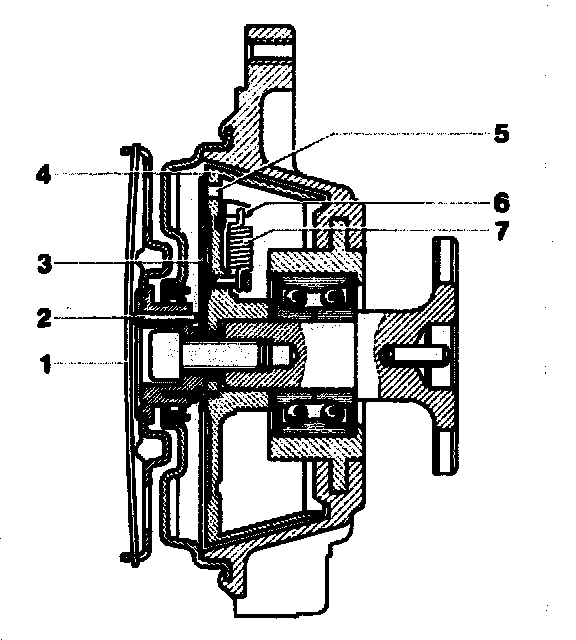
1 Bimetallic strip
2 Pin
3 Spring plate
4 Primary or drive disk
5 Transfer bore
6 Closing lever
7 Tension spring
If the temperature of the air blown by the fan is below approx. 105 °C, the bimetal strip (1) presses on the pin (2) and pushes the spring plate (3) onto the primary disc (4). The transfer bore (5) will then be covered and the circulation of the viscous oil will be interrupted. The viscofan clutch is disengaged and the fan rotates independent of the engine speed at 400-600/min ; but the fan speed will not exceed a maximum of approx. 600/min even at maximum engine speed
Starting at a coolant temperature of approx. 105 °C, the bimetallic strip (1) is heated by the air flowing through the radiator so that it will change its shape and arch in an outward direction. The spring plate (3) can now clear the transfer bore (5), as a result of which the circulation of the viscous oil is established and the viscofan clutch is engaged.
The fan now rotates up to an engine speed of approx. 3850/min, proportionate to the engine speed, hut not exceeding a fan speed of approx. 3000/min under influence of the transmission ratio of the belt drive and of the slip in the viscofan clutch. With further increasing engine speed. the fan clutch will disengage and the fan will rotate independent of the engine speed at 400-600/min, but will not exceed a maximum approx. fan speed of 600/min even at maximum engine speed.
If the engine speed drops to approx. 3400/min in, the viscofan clutch will again engage.
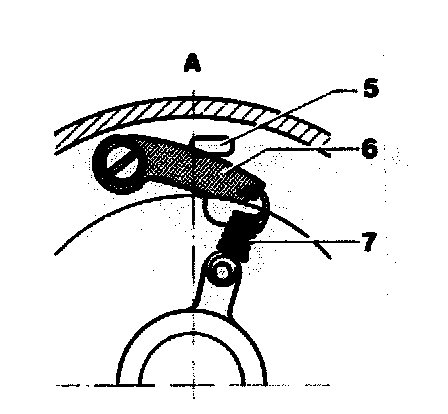
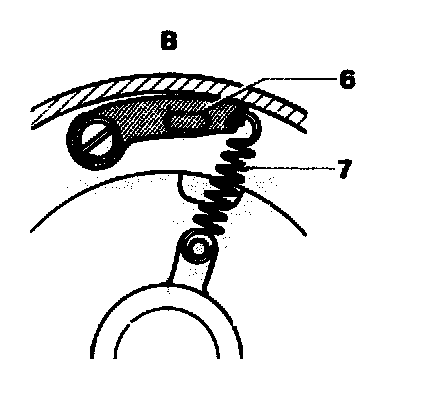
A a coolant temperature of approx. 105 °C engagement and disengagement is controlled by the closing lever (6) which, at increasing speed under influence of centrifugal force acting against force of tension spring (7), is gradually pushed over the transfer bore (5) until the bore is completely covered, thereby interrupting the circulation of the viscous oil (B, cut-out position). Under influence of the dropping speed. the effect of the centrifugal force on the closing lever is gradually reduced so that the lever can be displaced by the force of the tension spring (7) against the centrifugal force, with the result that the transfer bore is gradually exposed and the circulation of the viscous oil is re-established (A, cut-in position).
With decreasing coolant temperature the bimetallic strip (1) will gradually cool down and its changing shape will increasingly displace the spring plate (3) by way of the pin (2) in the direction of the primary disk (4) until the spring plate closes the transfer bore (5) not later than at a coolant temperature of approx. 95 °c The circulation of the viscous oil is interrupted, the viscofan clutch will disengage.